Can a photograph prove where it came from?
What Content Credentials can tell us about an image, and why provenance still needs context.
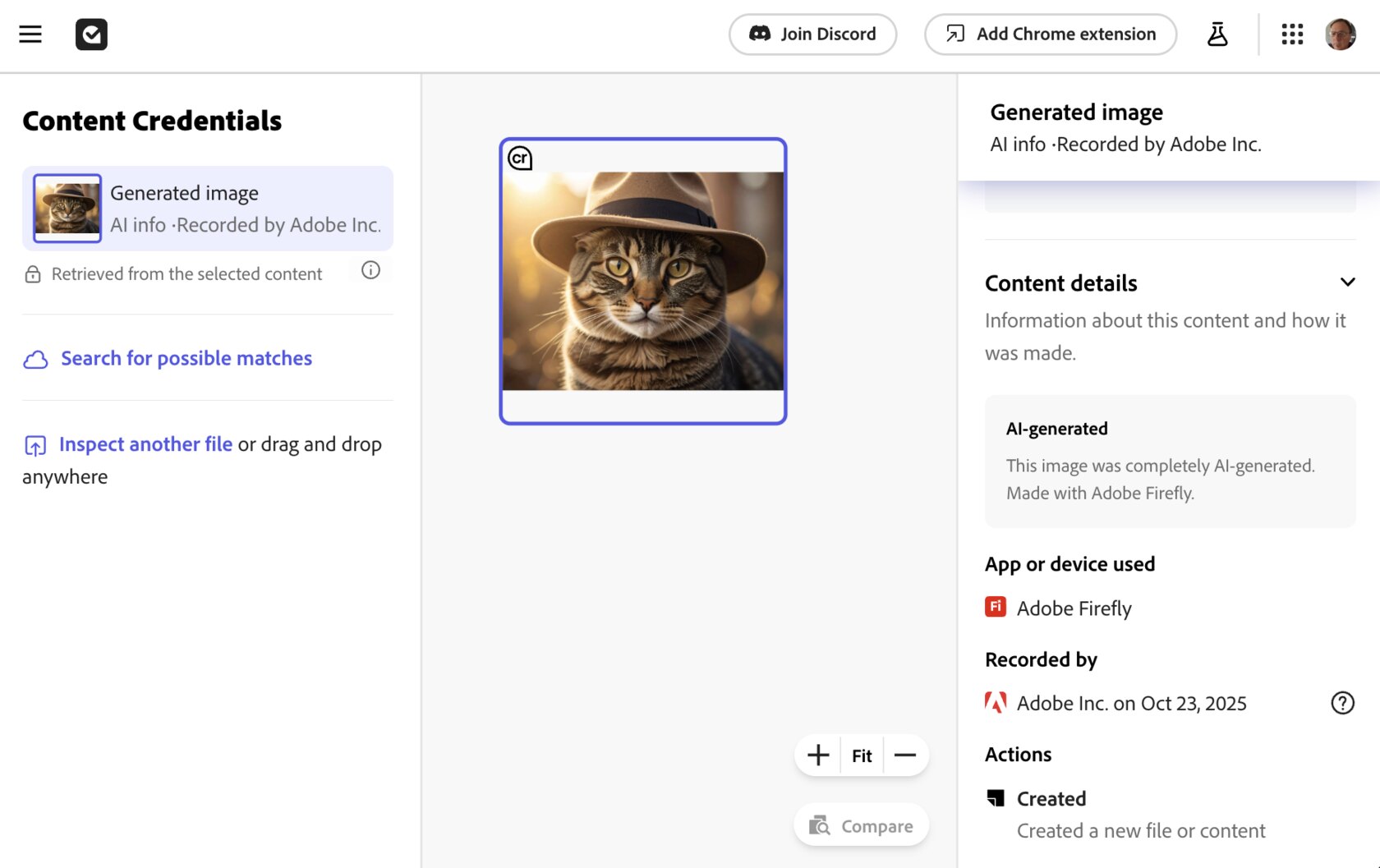
Content Credentials record information about the origin and history of digital media using the C2PA standard. They can attach signed statements about capture or editing to an image, helping a viewer inspect the information a participating tool has recorded.
A record, not a verdict
The technology makes provenance information tamper-evident. It does not decide whether a scene was staged, whether a caption is accurate or whether a photograph is being used in the right context. Those remain editorial questions.
Equally, a photograph without credentials is not automatically a fake. Older cameras, unsupported software and distribution workflows may not preserve this information. Missing evidence is different from evidence of manipulation.
A useful habit
Keep original files, maintain clear captions and look at the recorded edit history when it is available. Treat provenance as one signal alongside the source, the circumstances and independent reporting. The C2PA’s own documentation explains the scope and limits of the system.
Separate three questions that often get mixed together
When a photograph circulates, people may ask who created the file, what happened to it and whether the story attached to it is true. Those questions overlap, but they are not interchangeable. A record of editing can illuminate a file’s history. It cannot independently establish everything that happened outside the frame. A viewer still needs reporting to understand why the photograph was made and how it is being presented.
Consider an ordinary example: a genuine photograph of a crowded station is shared beside a claim about an event on another day. The pixels may be unchanged, and the capture record may be useful, yet the new caption can still mislead. This is why provenance should expand the questions an editor can answer rather than collapse the whole verification process into a single reassuring symbol.
Read the available record with care
The presence of a credential is a reason to inspect the information it contains. Look for the source of the statements and the actions recorded, then consider what is absent. Do not substitute a vague impression of technical sophistication for reading the actual record. A history is useful to the extent that its contents address the question you are trying to resolve.
Equally, resist treating a missing record as an accusation. Your family archive, an older camera or a legitimate publishing workflow may produce an image without visible credentials. The correct response is to seek other evidence. Original files, direct contact with the photographer, contemporaneous reporting and a careful examination of context can remain relevant. One missing signal should not erase every other reason to trust a source.
A practical desk workflow
Start by identifying the claim attached to the photograph. Is the claim about a location, a date, a person or an editing operation? Then gather evidence suited to that claim. A provenance record may help with part of the inquiry. It should be considered alongside the caption and the circumstances in which the image reached the publication. Keep notes that distinguish what was checked from what was merely supplied.
If uncertainty remains, describe it accurately instead of filling it with confidence. An editor can say that an image’s origin has not been independently confirmed, or choose to wait before using it. Those are editorial decisions, not failures of a technology. The goal is a defensible account of the evidence available at publication, including the limits that matter to a reader.
Editing and deception are different categories
A recorded adjustment does not automatically tell you whether an image is appropriate for a particular use. A fashion illustration, a personal artwork and a news photograph can operate under different expectations. The relevant policy should explain which changes are allowed and how material alterations are disclosed. A provenance system can contribute information; the publication must still decide how that information relates to its standards.
Avoid the equally unhelpful assumption that a photograph with no recorded edit is beyond question. A scene can be arranged before capture, a relationship can be misidentified or a limited view can be presented as a complete account. The shutter does not perform the reporting. Technical evidence and human accountability work together when each is asked to answer the questions it can actually address.
Keep a useful archive before you need to prove anything
For your own work, retain original files and clear records of the assignment. Record accurate names, dates and locations, and preserve the connection between a final export and its source. If a client or publisher has specific requirements for edit history, agree on them before delivery. A consistent archive makes later questions easier to answer, whether or not credentials were part of the capture process.
Build a small delivery check into your routine. Inspect a final file after it has passed through the actual export and distribution route. Confirm the caption, credit and any required provenance information at that point. A workflow should be evaluated from the file the recipient receives, not only from the state shown inside the application that produced it. Document any uncertainty rather than claiming preservation you have not checked.
Explain the signal to the audience
A reader should not need to become a specialist to understand why provenance information matters. A clear explanation can say what the publication has verified, what the record shows and what remains a question of context. Avoid interface language that turns a complex judgment into a universal “real” or “fake” verdict. Overstating the meaning of a signal risks undermining the confidence it was meant to support.
This applies to positive and negative labels alike. If a publication introduces an authenticity indicator, it should make the interpretation accessible without suggesting that every unmarked photograph is suspect. Readers encounter mixed archives containing many legitimate workflows. Good explanation helps them navigate that variety; an unexplained badge can simply create a new shortcut for misunderstanding it.
What photographers can do now
You do not need to abandon a reliable camera because it lacks a particular provenance feature. Begin with practices you can maintain: organized originals, accurate captions, clear credits and an honest account of consequential editing. Explore supported tools when they fit the work, and read the standard’s own documentation rather than relying on a product’s broadest marketing language. Ask which information survives your actual workflow.
The larger issue is trust, and trust is built through repeated, accountable decisions. Credentials can make some of those decisions easier to inspect. They cannot replace the photographer’s explanation, an editor’s judgment or the reader’s need for context. Used carefully, the technology becomes a useful addition to photographic evidence. It works best when its limits are understood as clearly as its promise.