35mm vs 50mm vs 85mm: framing, distance and the photographs you make
Compare three familiar focal lengths, account for sensor format and learn why camera position changes perspective.
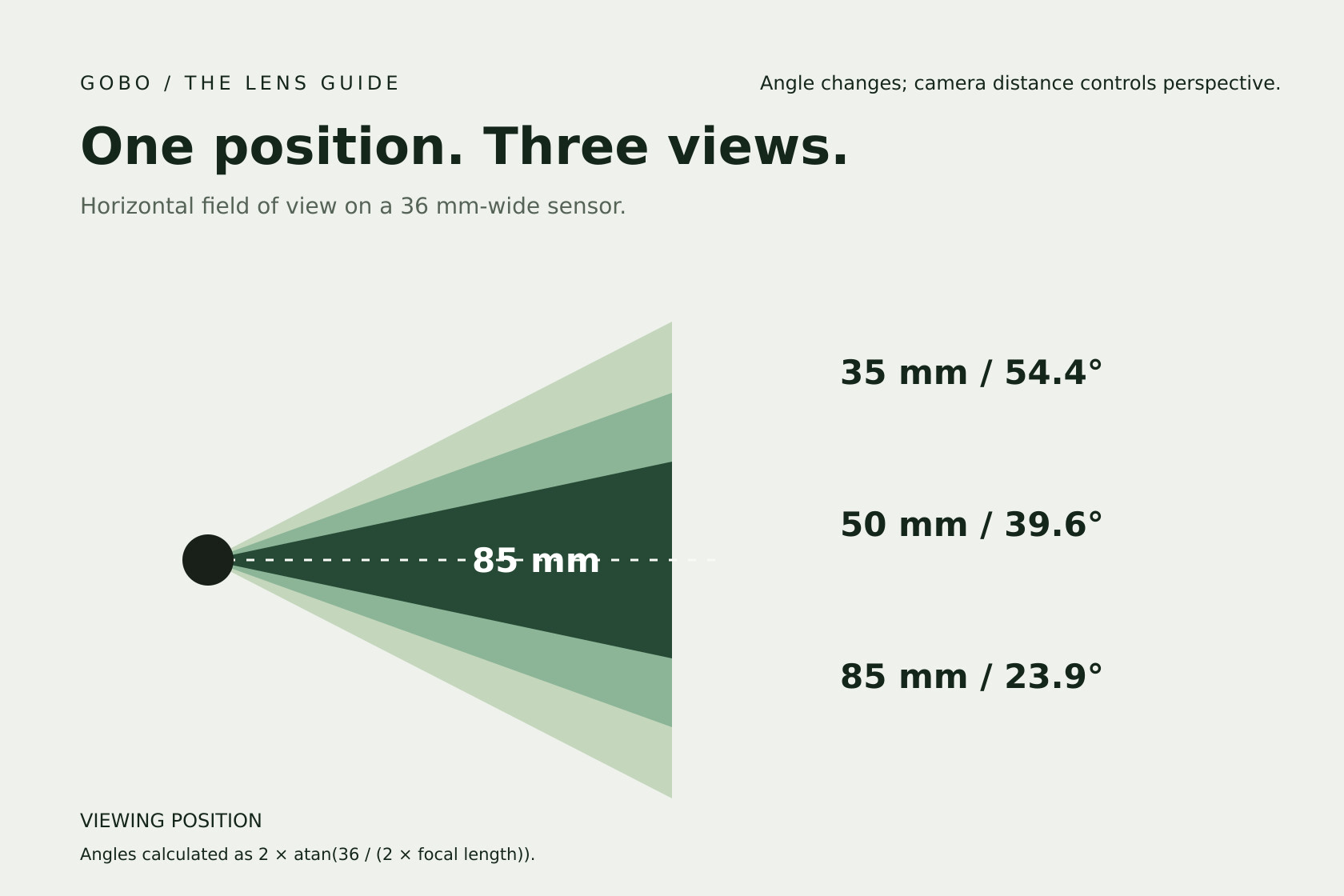
The choice between a 35mm, 50mm and 85mm lens is often presented as a contest with one correct winner. A better question is where you need to stand and how much of the scene belongs in the photograph. A small room, a busy pavement and an outdoor portrait session can favor different answers even when the subject is the same person.
This guide uses the angle of view of these focal lengths on a full-frame camera as its reference. It offers a composition exercise and a way to choose a working distance, rather than a ranking of particular lens models. Maximum aperture, minimum focusing distance, size and optical behavior still depend on the specific lens.
| Focal length | A useful starting purpose | A practical constraint |
|---|---|---|
| 35mm | Include a person and their surroundings | Watch distracting edges and very close working distances |
| 50mm | Balance subject and setting | May still be too narrow in a small room |
| 85mm | Select a tighter portrait and simpler background | Needs more working space for similar framing |
First, establish your sensor format
The number printed on a lens is its focal length. Mounting it on a smaller sensor does not change that number, but the smaller sensor records a narrower portion of its image. Nikon's focal-length guide explains the relationship between focal length, angle of view and sensor format. Equivalent focal lengths describe comparable framing, not a physical transformation of the lens.
For example, with a 1.5× crop factor, a 35mm lens gives an angle of view roughly comparable to 52.5mm on full frame. A 50mm becomes approximately 75mm in that framing comparison, and an 85mm approximately 127.5mm. Check your camera's actual crop factor; APS-C formats are not all identical. Aperture remains the marked f-number for exposure, while matching depth of field across formats involves additional choices.
35mm: include the surroundings deliberately
On full frame, 35mm is a moderately wide view that can make the setting part of the story. Think of a baker with the workbench, an artist in a studio or friends around a small table. Its usefulness comes from what you can include, which also means you must take responsibility for distracting edges and unrelated background objects.
Look around the entire frame before pressing the shutter. Is a bright doorway competing with the face? Does a nearby hand appear disproportionately large because it is much closer to the camera? A wider composition is not automatically a stronger environmental portrait. Give the surroundings a clear job, and adjust your position until subject and setting support each other.
For tight headshots, working very close can exaggerate the apparent size difference between nearer and farther facial features. That is a camera-distance issue. If the close perspective is unsuitable, step back and reconsider the framing instead of expecting a lens label to make the distance irrelevant.
50mm: a flexible middle ground
A 50mm lens on full frame often provides a useful compromise between showing a setting and isolating a subject. It can work for details, informal portraits and scenes with a little breathing room. It does not literally reproduce human vision: our visual experience includes peripheral awareness, eye movement and attention that a single rectangular photograph cannot duplicate.
Its practical limits become clear indoors. If a wall prevents you moving back, a composition that fits at 35mm may not fit at 50mm. Conversely, when you want to remove some surrounding clutter without standing far away, the narrower view can help. Test it in the rooms where you actually photograph rather than choosing from attractive outdoor examples alone.
85mm: a narrower selection of the scene
An 85mm lens on full frame gives a short-telephoto view. It is a useful option when you want a portrait with fewer surrounding elements and have room to work farther away. A small change in shooting position can place a simpler patch of background behind the face, making composition cleaner without requiring a completely empty location.
The working distance also affects the interaction. You may need to speak more clearly, walk farther between adjustments or manage people passing through the space between you and the subject. In a compact apartment, you might run out of room for anything wider than a tight portrait. Consider those everyday constraints alongside the appearance of the background.
Perspective comes from camera position
Professional Photographers of America's lens-selection material makes an essential distinction: changing focal length from the same camera position changes angle of view, while changing position alters perspective. If you photograph a scene from one spot with 35mm and 85mm, the shared portion has the same perspective, setting aside lens distortion and other optical differences.
Now keep a person's head the same size in the frame. With 35mm you stand closer; with 85mm you move farther away. Those different positions change the relative apparent sizes of the face and background. The familiar description of telephoto compression is useful shorthand, but understanding the role of distance gives you more precise control over the result.
Run two comparisons with the equipment you have
If you own a zoom covering the range, set it to 35mm, 50mm and 85mm without moving the camera. Compare the framing and crop the wider photograph to inspect the shared area. This first exercise separates angle of view from position. It does not compare the sharpness of three prime lenses or simulate their maximum apertures.
For the second exercise, maintain similar subject size by moving between focal lengths. Keep camera height, lighting and the subject's position consistent. Notice the face, background scale and how the interaction feels at each distance. These are proposed exercises, not published test results, and the most informative outcome is which arrangement helps you make the photographs you intended.
Choose around the work you repeat
Review a recent set of photographs and identify the recurring limitation. If you constantly step into a wall, a wider view deserves consideration. If backgrounds remain busy despite careful positioning, explore a narrower view. If you mainly need a light everyday kit, compare the actual dimensions and weight of the lenses available for your mount.
Rent or borrow before making an expensive purchase where possible. Spend time in an ordinary room and on a normal walk, not only in an ideal location. The strongest choice is the focal length whose working distance and framing suit your repeated needs. The other focal lengths remain useful options when the subject, setting or intention changes.